
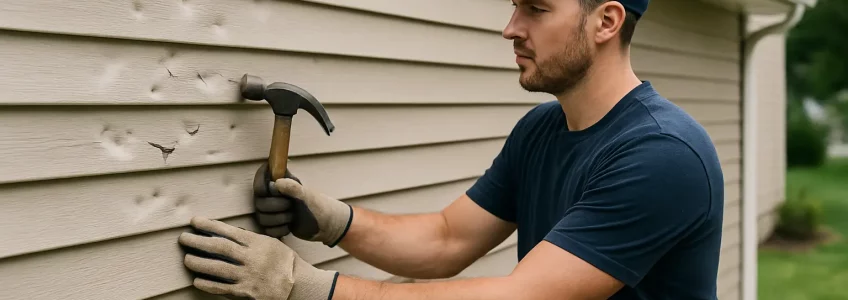
Hail doesn’t have to be the size of a baseball to create a long-term siding problem. In Minnesota, the more common scenario is a fast burst of hard pellets driven sideways by wind. It leaves your home looking mostly fine from the street, but a week later you notice new cracks, dents that catch the evening light, or a corner that suddenly looks “wavy.” That’s the moment to treat siding repair after hail as a time-sensitive project, not just a cosmetic touch-up.
Why hail damage on siding is tricky
Unlike a roof, siding damage can hide in plain sight. The wall still sheds water during the next rain, so it’s easy to assume you can wait. But hail often creates micro-fractures, loosened seams, and impact points that are perfectly positioned to let moisture in later – especially during freeze-thaw cycles.
The other challenge is proof. Insurance decisions typically depend on whether the damage is functional (it compromises performance) or purely cosmetic. Some siding types show obvious dents. Others crack internally and only reveal the problem months later when paint fails, panels warp, or moisture shows up around windows.
What hail damage looks like by siding type
Hail doesn’t “damage siding” in one universal way. The material you have changes what to look for and what a repair can realistically accomplish.
Vinyl siding
Vinyl often cracks at impact points, especially on colder days when it’s less flexible. You may also see chips or “punched” holes near panel edges or around corners where the siding is under more tension. If panels are cracked, that’s typically considered functional damage because it can allow water behind the wall.
Fiber cement (Hardie-style)
Fiber cement is durable, but hail can chip the finish, fracture corners, or create spider-cracking around nail lines. The board might look intact from a few feet away, yet the paint film is broken. That matters because the finish is part of the moisture defense. Repairs range from spot replacement to full wall elevations depending on how widespread the impacts are.
Engineered wood and traditional wood
Hail can dent wood fibers, split edges, and accelerate paint failure. Once the coating is compromised, moisture and sun take over quickly. For wood-based products, the “repair” conversation often turns into a “how to stop future rot” conversation, which can mean replacing damaged sections and repainting to a uniform finish.
Aluminum and steel siding
Metal siding can dent without actually opening up. That’s where the claim and repair decision can get complicated. Dents may be classified as cosmetic, and they can be difficult to correct without replacing panels. Also, matching older metal profiles and colors can be difficult.
The first 48 hours: what homeowners should do
The goal early on is simple: protect your claim options and prevent secondary damage.
Start with photos, but take them with intention. Get wide shots of each elevation, then closer photos of specific impacts, and finally a few “context” shots that show the location (for example, hail strikes near a window corner, next to a downspout, or along a high-exposure wall). If you have leftover siding in the garage or basement, photograph the label and profile too – it can help with matching later.
Next, do a quick perimeter check for hazards and water entry points. If a panel is cracked open or a corner piece is missing, temporary protection is reasonable. Just avoid sealing things up permanently with caulk or adhesives that could complicate a proper repair and inspection.
Then schedule an inspection sooner rather than later. Hail events hit neighborhoods at once, and reputable contractors get booked out. Waiting can also blur what came from this storm versus normal wear.
What a real siding inspection includes
A meaningful inspection is more than a glance from the driveway. For siding repair after hail, you want someone who checks exposure patterns and failure points.
They should look at the elevations that took the brunt of the storm (often the west or southwest sides in Twin Cities storms), then inspect corners, J-channels, window and door trim, and areas around penetrations like hose bibs and vents. Those are common spots where impacts create gaps.
They should also check related components. Hail that damages siding often hits fascia, soffit, gutters, window wraps, and even exterior light fixtures. Sometimes the “siding claim” is supported by a broader exterior damage picture.
Repair vs. replace: the decision points that matter
Every homeowner wants the simplest fix. The question is whether a simple fix will actually hold up and look right.
When repair is realistic
Repair can be the right call when damage is limited to a small area, the siding is still available, and color matching is achievable. A few cracked vinyl panels on one elevation, for example, can often be replaced cleanly if the siding isn’t discontinued and sun fade isn’t severe.
Fiber cement repairs can also be targeted when damage is localized and you can repaint the repaired area or the full elevation for a consistent look.
When replacement makes more sense
Replacement is usually the better path when impacts are widespread, when panels are discontinued, or when matching is unlikely. Even if you find the same product line, UV exposure can make new panels stand out.
It also depends on the age of your siding and the condition of the weather-resistive barrier and trim. If you’re already dealing with brittle vinyl, repeated prior repairs, or deteriorating wood trim, a hail event can be the moment where replacement stops being “extra” and starts being the durable, cost-effective option.
There’s also a building-performance angle. If you’re opening up multiple walls, it may be the right time to address flashing details, housewrap repairs, and ventilation components that protect the structure for decades.
How insurance typically approaches hail-damaged siding
Policies vary, and the details matter. Some cover replacement cost value, others actual cash value. Some treat cosmetic damage differently than functional damage, especially on metal.
A common friction point is “spot repair” versus “reasonable uniform appearance.” If only a section is approved but matching isn’t possible, homeowners can get stuck with a patchwork look unless the documentation is strong and the scope is negotiated correctly.
This is where your contractor’s documentation and claim experience matters. Clear photos, test squares when appropriate, product identification, and an itemized scope that includes trim, wrap, and labor realities can change the outcome.
If an adjuster visit is scheduled, have your documentation ready and walk the property with them if possible. Point out the elevations that took the storm head-on and the specific functional issues: cracks, holes, loosened seams, broken corners, and compromised coatings.
Material and color matching: the part nobody warns you about
Even when insurance approves repairs, homeowners are often surprised by how hard matching can be.
Vinyl is notorious for fade. Fiber cement can be repainted, but that’s an added scope decision. Metal profiles may be discontinued. If your home has a unique color or older product line, the best “repair” on paper may not be the best result in real life.
Talk through matching before you authorize work. Ask what the plan is if the new panels don’t blend, and whether the recommendation is to replace a full elevation for consistency. A quality contractor will explain the options and the trade-offs instead of promising a perfect match that doesn’t exist.
Timing matters in Minnesota weather
Hail season overlaps with humidity, heavy rain, and the start of fall temperature swings. Siding that’s cracked or loose can funnel water behind the wall, and once moisture gets into sheathing or framing, repair costs can climb fast.
That doesn’t mean you have to panic-replace everything. It does mean you should avoid the “we’ll see how it does this winter” approach when there are visible cracks, missing pieces, or exposed edges. Those are the situations where fast, correct repairs protect the structure.
Choosing the right contractor for hail-related siding work
Storm restoration attracts everyone – including crews that disappear when the final check clears. You want a contractor who will still answer the phone if you have a question next month, or if the manufacturer requires a specific installation method to maintain warranty.
Look for licensing and insurance, local history, and a process that includes written scopes, property protection during construction, and clear communication. If an insurance claim is involved, you also want someone who can speak the language of documentation and scope, not just installation.
If you’re in the Twin Cities area and want a contractor who handles both the build and the claim side, A to Z Construction offers free storm damage inspections and can guide the process from initial documentation through final repairs. You can start that conversation at https://www.atoz-construction.com/.
What to expect during the repair process
Once scope is agreed on, the best projects feel organized. Materials are confirmed, color and profile are verified, and sensitive areas like landscaping, decks, and AC units are protected.
During installation, proper flashing and water management should get as much attention as the panels you see. That includes window and door trim transitions, kick-out flashing where rooflines meet walls, and clean detailing around penetrations. A “pretty” siding job that shortcuts flashing is how you end up with hidden rot.
After completion, you should get a final walkthrough and a cleanup that actually looks like it – magnet sweep for nails and fasteners, debris removed, and details checked in daylight.
A helpful closing thought
After a hailstorm, the best next step isn’t guessing whether the dents are “bad enough.” It’s getting a clear, documented answer on what’s damaged, what can be repaired without future headaches, and what should be replaced to keep your home tight, dry, and looking like it was done on purpose.